Posts

Showing posts with the label History of tea

Three tea stories (3) — The merchant's pride

Image
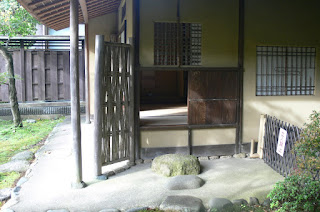
The stories I am telling here have few historical background. They are merely legends decorated by my imagination.    Just like anything that belongs to a fantasy of the past, they are as true as one would like them to be. But it is sometimes so comforting that a story could be true that it does not matter if it really is or not. It is said that, in the Japanese world of warlords, merchants were traveling all the way to China and India to provide their masters with the greatest weapons and crafts. But as payment, they only received and handful of gold and despise. So, one day, a merchant well versed in Zen and tea desired to finally get respect. In order to do that, he decided to build quite a peculiar tea room. When a lord arrived there, he would be met with a garden deprived of any splendor. At the back of it, a weak construction was waiting for him. At the entrance, he had to leave his sword and to enter through a small square door that none could pass wit...

Three tea stories (2) — Chinese Paradise

Image
The stories I am telling here have few historical background. They are merely legends decorated by my imagination.    Just like anything that belongs to a fantasy of the past, they are as true as one would like them to be. But it is sometimes so comforting that a story could be true that it does not matter if it really is or not. The celestial pavillon It is said that in ancient times, the Chinese literati used to meet in very remote pavilions, somewhere at the back of a mountain. The path leading to it could be very perilous. Many hours   of walk and great dangers awaited the courageous mandarin. But eventually, shortly behind a cliff or a bambou forest, he was discovering a lonesome hut with a view on the sky or a lake. Entering the place, the literati leaves behind any political or personal feud. The world of men has been temporarily suspended. Only the open hearts and high minds remain. Participants hold a giant brush made of yack hair. They use it to...

Three tea stories (1) — The buddhist drug

Image
The stories I am telling here have few historical background. They are merely legends decorated by my imagination.   Just like anything that belongs to a fantasy of the past, they are as true as one would like them to be. But it is sometimes so comforting that a story could be true that it does not matter if it really is or not. The buddhist drug It is said that Bodhidharma, father of the Chan buddhism, decided one day to meditate for nine years in front of a wall without sleep. Nevertheless, one day, his eyelids got heavy and he eventually closed them. When He woke up, he was extremely mad at himself. So as to not reproduce the same mistake, he tear his eyelids and threw them on the ground. From that same ground the first tea tree was bon. Bodhidharma’s disciples turned it into a drink by grounding the leaves and served it to the master. Hence, never again did he got sleepy during meditation. In the Chinese temples of the Chan sect (Zen in Japan), tea powder bec...

Tea briefing #3 : Tea history between tales and legends

Image
Or why is it so hard to write anything non-polemical about Tea ? « Any miso soup left ? » —Kobori Enshu (probably.) (Quote also more arguably attributed to Hideyoshi Toyotomi) The subject of the tea ceremony and its history is so sensitive among practitioners today that to write a consensual introduction to the tea ceremony is a very difficult task. It is partly due to the fact that contradictory information is common.  Certainly, most people agree very vaguely on the chronology and the basics of Tea. But everything regarding the spirit with which it must be practiced and the interpretations to give to the countless legends and tales that go with it is the subject of great debate. Anyway, that is why I will only stick to the few things that I have understood from my various readings and conversations in the hope that it will be interesting to my readers. I have no pretension to present here the one and unique truth about what tea is or...

Tea briefing # 2 : what does it mean to practice of tea ?

Image
The seven rules of Tea :  “First you must make a delicious bowl of tea; lay the charcoal so the water boils;  arrange the flowers as they are in the field;  i n the summer suggest coolness,  in the winter, warmth;  do everything ahead of time; prepare for rain;  and give those with whom you find yourself every consideration.” — Sen no Rikyu  (who liked to improvise such sayings) In any tea ceremony, there are at least three steps : purification of the ustensiles, preparation of the actual tea and the cleaning of the ustensiles. To my knowledge, these are the incompressible steps that any tea practice include, even for a minimal tea event. Broadly speaking, what is a « tea ceremony » ? It is an event organized by a host in a place that is adequate or not for tea and to which the guests attend generally with some preparation. A great deal of codes govern over the behavior of the host and his way of serving tea (and,...

Tea briefing #1 What is this Tea ceremony thing ?

Image
If one had to define what is the tea ceremony, how s/he should proceed ? " Tea is nought but this: first you heat the water, then you make the tea. Then you drink it properly. That is all you need to know." — Sen no Rikyu  (also the author of hundreds of other maxims on Tea that render this one much more esoteric) Enter a world of simplicity... The Japanese name of the tea ceremony is Sado ( 茶道 ). Sado should be translated as the Way of Tea. And " Way " must be understood here in its Asian meaning as a path that shapes one’s life, the occasion to meditate at all time on how to behave. But the tea ceremony is also sometimes called chanoyu ( 茶の湯 ) which means " hot water of tea ". Their are many explanations to this name and I will just mention one of them : it is supposed to remind hosts and guests that tea is simply the act of serving tea.  One could already feel the paradox that runs through...

Tea brief #4 : the diversity of tea between two poles

Image
" At this time, the places where Cha-no-yu was most flourishing were Sakai in the East and Hakata in the West. The spirit of Sakai was esoteric and calm, that of Hakata dignified and magnificient. Rikyû and Sôkyû were typical of the East, Sôshitsu and Sôtan of the West. Of Hideyoshi it might be said that he was inclined to make the East his teacher and the West his friend. " — A.L. Sadler, The Japanese Tea Ceremony Based on what I could read, one can identify two " spiritual roots " to modern Tea.  I use the term « root » here but these two practices are certainly not the only practices that inspired modern Tea. I see them rather as « poles » of the practice of tea. These two poles are : the wordly pole (or court pole) and the meditative pole. Are the two cities mentioned by A.L. Sadler (who is only quoting a text here but the reference is lacking) matching these two poles ? I cannot say for sure. Tea Ceremony by Chikanobu Toyohara (1838-1912) ...

If you like it share it !