Posts

Showing posts with the label Sasaki Kyoshitsu

Japanese Scent

Image
Melody in wood I still remember my first trip to Kyoto. It was in July. One day, while some scattered rains washed the trees and refreshed the airs with a soft wind, I entered the walls of Nanzenji, one of Kyoto’s famous temples. The great gate and its darkened wood pillars exhaled a perfume close to incense and moss. A top note, sparkling and emotional, came from nose to eyelashes like tears of joy. Then an earthy wave, the middle note, fresh and light like a breeze among the oaks. And finally, for the base note, a deep blow of sliced wood, low and rich, rough on the palate and caressing on the nose. I never forgot that perfume of Nanzenji. To me, it is typical of central Japan. I think I mentioned it a lot before. I had to, eventually, give it a proper homage. The missing history of perfumes Tanizaki said that Japanese aesthetic plays on shadows to suggest things rather than to show them. I never read anything about the smells of Japan. Yet, more so than shadows,...

Chakaiki — A new invitation to wanderings

Image
After our last firing, Sasaki-sensei and I prepared tea together. In ancient times, tea people would write down records of their tea ceremonies and of the most important pieces they saw. It was called a chakaiki . This is a modern chakaiki with pictures and commentaries. Tokonoma — white boats and blue beauties All of this trip was made possible thanks to the help of Alex Kerr, a famous american writer in love with Japan and expert in —at least— calligraphy. As Sasaki’s friend, he accepted me in his old house full of treasures, only forty minutes by bicycle from the workshop —and that was the closest house ! My legs will certainly remember the seven endlessly uphill kilometers that I had to ride every morning in the mountains. But my heart will surely also remember Alex Kerr’s generosity. Before I left the house, Mr. Kerr offered me one of his calligraphy. He signs his works instead of using a stamp — I think that is his way of playing between Western and Eastern trad...

World creation by Sasaki Kyoshitsu

Image
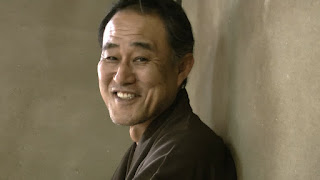
Sasaki during our last firing at Shoraku About two weeks ago, I asked Sasaki-sensei to make two tea bowls. The first one had to be made for his personal use, the second for his family. None of them should be made to be sold. What did he understood of my words ? I have no idea. Nevertheless, he started to make four bowls… Later, he would explain that it was a way to make sure that at least two would survive…but each bowl he made was different. One of these tea bowls will be my « ceramic » conclusion to this internship. Master’s style Sasaki-sensei il a smiling and sweet man, convivial and fond of bright colors. He loves shiny green glazes, chalk white shoes and the Japanese tapas bars where saké is overflowing.   A black or a red raku tea bowl is not exactly the perfect expression of his character. One can feel it in Sasaki’s works. His creations alternate between classic dark/red and colorful essays. Sasaki's tea bowls Before our last fi...

The dialectic between the master and the potter

Image
Reaching the end This is the end of my experience.  On the 2nd of August, I went up in the mountain one last time, to Shoraku workshop.   Right in front of me, Sasaki-sensei fired the pieces that I asked him to design for his family. Then I had to choose the pieces I would bring back to Paris…or somewhere else…and we made tea together, one last time, with our tea bowls still burning hot. Why did I decide to make this trip ? Why ceramic again ? This question never left me. Freedom of the slave Hegel said that the master think s/he is free because the slave obeys him but that, in fact, the slave learns to act on the world itself while the master is everyday more dependent him/her. The dialectic between the master and the slave is, among other things, that the one that is at first deprived of freedom is in fact getting more freedom that the one that thinks that s/he is free. Tea masters buy ceramics that they never make. They organize i...

Pascali Ceramicum Schizophrania

Image
Let's all rejoice for the very first surviving chawan is out of the kiln...many died in the way Pascal in two minds Pascal once wrote that there was two kind of minds : the intuitive and the geometrical. No mind is purely one or the other without being totally wrong but each has its preference. The geometrical mind knows how to formulate great principles and categories that are difficult to apply. « Thou shall never lie » says the geometrical mind, and it does so with an almost laughable   mathematic rigor. Such kind of mind is not wrong in the way it uses reason but its principles are not adapted to society. Meanwhile, the intuitive mind see the principles that fits each situation but are unable to formulate or even understand great principles that are not in their society.   Long story short : one think but does not see, one sees but does not think. To think or to see, you choose ! Yet, some situations require a certain mind and not the ...

Chawan shot : the new born mountain

Image
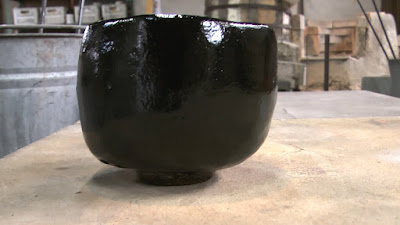
The new born mountain On a dark glaze screen,  a moss of white rock has invaded the tea bowl.  The mountain is getting back what is rightfully hers. Extracting itself from the shadows, she is still fizzling.  Her shape is unclear and diluted like a cloud. She barely outcrop. Crimson gleams shimmer under the surface,  where the earth has yet to be opened. It is a great privilege to hold a mountain in her youth and to drink from her bosom  the first sprouts of tea. Black Oribe chawan by Sasaki Kyoshitsu II

Chawan lover #3 : wabi-sabi and ceramic meditation

Image
A ceramic meditation A Chôjiro style tea bowl from Shôraku workshop. Nothing is more still that burnt clay.   But the light keeps dancing on ceramics with an astonishing refinement. And very often, the most imperfect and simple pieces are the most playful with their environnement. Sometimes, I think that this specific relationship with environnement is one of the roots of the wabi-sabi aesthetic : it creates what I call a welcoming nature . Arts and their nature Frame itself separates the art from our world Most of the western (but also eastern) arts exhibit a strong human presence. The art is somehow remarkable , a human intention separates it from anything that could be called ‘natural’. The vivid colors, the geometrical lines, any pattern or drawing that could be described as more or less realist — which, in fine , means that it creates its own reality — all of these are different ways to distinguish the « human » world made by art from the «...

knowledge and knowhow in ceramics

Image
Newsletter #3 Are we learning to climb Mt. Fuji from top to bottom ? Skill without knowledge « All the wisdom in the world will not make us wise ». During my last trip to Japan, I wondered about the reasons that made me reluctant to start a philosophy Ph.D. This question had bothered me for more than a year at that point. This maxim I thought of was my answer : philosophy turned out to be a disappointing way to become wise. To be wise cannot be achieved by the accumulation of knowledge on what is the good life or our society. Spinoza once said that one can bend his will through knowledge but it might not work with me and many others I know. To be wise, one has to « desire » it… but there is no knowledge that can push us until we actually act wisely. I understood it in quite an odd way recently at the workshop of Sasaki. When I started this new internship, I had already gathered quite a few informations about the techniques required to make a nice t...

A potter's responsibility

Image
Newsletter #2 When you do pottery, a lot of people think that there is remorse, but there is not : what has been done cannot be changed. It gives a strange feeling of responsibility. Consequences of a movement This responsibility starts as soon as the clay is being made. To prepare it, one has to definitely mix different dirts and sands. Then comes the moment when one has to decide on the general shape of the piece that will later be carved. This  big lump of clay might look harmless, but it is already deciding a lot about what will come next. As soon as the hand lays for the first time on the clay, it is already taking a step toward a certain direction. And then, each move has influence on the whole piece. There is no surgical operation that can correct but do not deregulate. Maybe, that is why the potter’s moves seem so simple : s/he has to be fast, shape everything in a single swoop and without retrieving any part of the piece that m...

Chawan lover #1 : a ceramic landscape

Image
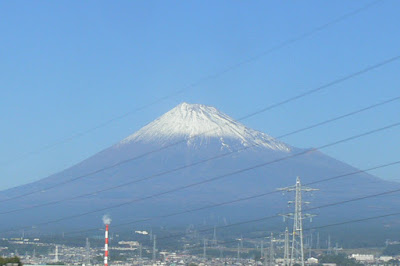
A mountain, a tea-bowl and thousands of pictures Few days ago, I was looking at one of Sasaki Kyoshitsu's  chawan  as I was making my own tea bowls in his workshop. Mt Fuji's shape was arising in bone white color on its shiny black side. It felt like it had appeared before me before a dark stary night. It gave quite a contrast with the gentle breeze of the early June and its almost shadowless sunshine. So I started to wonder : why is Mt Fuji so fascinating ? Mt Fuji is certainly a landscape in itself. No need to draw anything around it nor to detail which face of it you are painting. Its shape is enough to make it recognizable on prints and advertisements. During my first trip to Japan, I could not see Mt Fuji and, at that time, I did not understood why the Japanese fancied this mountain so much since it is not so high nor peculiar. I then thought that the Japanese loved their unique "big" mountain like some villages in France love their only church.  ...

Ishin denshin or : talking through silence

Image
Newsletter #1 Experience without words At Sasaki Kyoshitsu’s workshop, we barely talk. Our main communication channels are hands, looks and practice. Simple laughter also. The Japanese people call that ishin denshin ( 以心伝心 ) : « what the mind think, the heart conveys ». That is non-verbal communication, implicit exchange — i.e. the hypothesis that we mutually understand each other. But is there any need to talk ? After the first explanations, each of us is alone in front of his workbench and sitting cross-legged (for those who can stand such a position for a long time)…facing the mountain out of the workshop. And then, the work begins, it is repetitive. Most of the time, no unique piece is made. I do « unique » pieces because I am unable to give the same shape to the clay each time. It comes only with a lot of time and practice. There is no real industrial method here. And the potter’s experience might give him something far greater th...

If you like it share it !